

This blog post is produced based on an interview with Kelvin Ching, Customer Success Manager for FiveStones. Kelvin has 7 years of performance marketing experience across finance and FMCG industries at Mediacom, iProspect, and PHD.
TL;DR
Performance marketing doesn’t scale forever—growth comes from adding demand, not just optimising capture. High-performing teams run brand + performance as one system (brandformance) to continuously bring in new users, nurture them, and convert them over time.
Early signs it’s working: bigger remarketing pools, more new users, stronger engagement, rising branded search.
Long-term impact: more stable CPA, better conversion efficiency, and scalable growth.
The blocker isn’t budget—it’s structure. Fragmented channels make it hard to control frequency, connect funnel stages, and measure properly. Centralised platforms like Display & Video 360 help operationalise full-funnel execution, from demand creation to conversion.
Bottom line:
If performance has plateaued, optimisation won’t fix it. Growth comes from building demand and feeding it into your funnel—then capturing it more efficiently over time.
In Part 1, we looked at why performance marketing goes wrong and how/why teams fall into the remarketing trap.
In Part 2, we’ll go into what high performing teams are actually doing right and updating our understanding of long term performance and building a structure around it. The end goal is to run campaigns that consistently generate new demand, feed it into your funnel, and convert it more effectively over time.
Brandformance: What High-Performing Teams Do Differently
Teams that continue scaling don’t rely on performance alone and they don’t treat brand and performance as separate efforts. Instead, they run both as one system: continuously bringing new users into the funnel, nurturing them, and converting them when they’re ready.
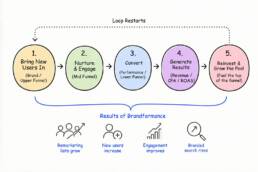
This is brandformance in practice — not a buzzword, but a shift in how growth is built.
The impact doesn’t show up in revenue first. It appears earlier in other ways:
- remarketing lists start growing again
- new user volume increases
- engagement improves
- branded search rises
“The first sign is your remarketing list starts growing again — that’s when you know it’s working.”
Kelvin, Customer Success Manager, FiveStones
Over time, this feeds directly into performance:
- Larger and newer audiences
- Better conversion efficiency over time
- More stable CPA
Essentially, campaign performance improves because there’s more demand to capture.
Why Brandformance Requires More Than Budget
A common reason most companies don’t do brandformance is mostly structural. The media mix involved in a standard campaign is often fragmented. To illustrate:
- search campaigns in one platform
- social in another
- display somewhere else
- reporting split across multiple tools
When you work across multiple platforms, it becomes a challenge to:
- control frequency
- manage audience overlap
- connect upper funnel exposure to lower funnel outcomes
- analyze true performance without deduplicating conversions
Scaling beyond performance requires proper coordination and a thought to structure, not just about budget allocations in your funnel activations.
A centralised platform: Where DV360 Fits
This is where centralized platforms like Display & Video 360 (DV360) work in your favour, as it allows you to plan and execute across the funnel. In practice, that could mean:
- using YouTube video ads to educate and build awareness
- using data-driven display creatives to scale reach and consideration
- feeding first party audiences audiences from first party sources like your CRMs into lower funnel campaigns
One key, practical advantage is building high-precision remarketing lists through optimized frequency control and third-party data integration, at scale:
“Scale remarketing list efficiently with DV360 by leveraging campaign-level frequency caps, vast inventory, and seamless third-party data integration.”
Kelvin, Customer Success Manager, FiveStones
More importantly though, investing into a singular platform like DV360 could allow marketing to make full-funnel execution operational:
- reach new users beyond existing demand pools
- maintain a consistent flow into performance campaigns
- operate across formats within a single system
Closing Summary and Next Steps
To summarize, if you’re seeing things in your campaign such as rising CPA despite optimisation, high frequency with flat conversions, limited new user growth you’re likely at the ceiling of performance marketing alone. At this stage, more optimisation won’t unlock growth. The shift isn’t about abandoning performance, but expanding beyond it: introducing demand generation, growing audience pools, and aligning activity across the funnel. That also means resetting managerial expectations as results take time, CPA may rise in the short term, and measurement becomes less direct.
If you’re already running performance campaigns and looking to grow further, the next step is connecting demand creation with demand capture. Download the DV360 Brandformance Playbook to see how this works in practice — from full-funnel structure to audience strategy and execution.
Download the DV360 Brandformance Playbook
If you’re already running performance campaigns and looking to scale further, the next step is understanding how to connect demand creation with demand capture.
👉 Download the DV360 Brandformance Playbook to see how this works in practice:
- full-funnel campaign structure
- audience strategy
- platform execution using DV360