


This blog post is produced based on an interview with Kelvin Ching, Customer Success Manager for FiveStones. Kelvin has 7 years of performance marketing experience across finance and FMCG industries at Mediacom, iProspect, and PHD.
TL;DR
Performance marketing doesn’t fail — it stops scaling. When growth stalls (rising CPA, flat conversions, heavy reliance on remarketing), the issue is not optimisation or platform choice, but a structural limit: lack of new demand entering the funnel.
Most teams respond by optimising harder, but this only improves efficiency — not growth. Without upper-funnel activity, campaigns end up recycling the same shrinking audience, leading to higher frequency, rising costs, and stagnant results.
The real constraint is behavioural, not technical. Teams over-prioritise performance marketing because it delivers fast, measurable results, while demand generation is slower, harder to attribute, and less visible in short-term reporting. As a result, budgets stay concentrated in lower funnel activity — even when it stops scaling.
Bottom line:
Performance marketing captures existing demand.
Growth requires creating new demand.
If there is one key thing to take away from this blog post, it’s that performance marketing doesn’t “fail”, but that it can reach a limit.
Ad ops and marketing teams usually don’t notice it immediately. This means that campaigns are still running, and conversions are still coming in. But over time, you see patterns that start to creep in, such as:
- CPA starts rising
- Conversion volume plateaus
- Retargeting performs — but doesn’t scale
- Prospecting struggles to deliver
A common reaction at this point is to somehow pivot to another optimisation strategy. So teams would be doing things like adjusting bids, switching creatives, testing another audience, or reallocating budget.
Results usually turn out the same, namely that growth will not occur. This is because the issue isn’t the campaign or the platform, but a structural limit.
The “Problem” with Performance Marketing
When a performance campaign that was working well seemingly goes the other way, a natural reaction is to isolate it to the platform. That’s why we change optimisation strategies and when things don’t improve, we blame the platform.
In reality, this is rarely the issue.
“The first instinct is always to blame the platform or hunt for a broken setting.”
Kelvin Ching, Customer Success Manager at FiveStones
While a change in optimisation strategy may improve efficiency slightly, teams will not solve long term performance if they are not understanding that optimization does not correlate with growth.
The Remarketing Trap Most Marketing Teams Fall Into
Performance marketing relies on a simple mechanic: find users who are likely to convert — and convert them. What’s sometimes misjudged is finding this constant stream of users who don’t appear on their own, but come from your upper funnel marketing.
Think of it as a flywheel: If that flow stops, performance stops.
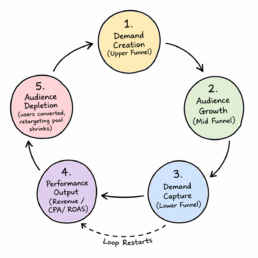
“If you don’t keep generating new users into your upper funnel, your performance campaigns will eventually run dry.”
Kelvin Customer Success Manager, FiveStones
What is not realised is that when you often do performance marketing, all you’re doing instead is repeatedly targeting the same shrinking audience. So you’ll see results like:
- Frequency climbing.
- Costs increase.
- Conversions stagnating
The truth is that by this point, you’re not scaling but recycling demand.
Why Do Teams Keep Doing the Remarketing Trap?
On paper, the solution is obvious: introduce new demand into the funnel.
However, in reality, marketers and their ad ops team aren’t really practicing it. The reasons for it are actually human in nature.
The lure of fast results
Demand creation doesn’t behave like performance marketing and it takes longer to show results. It doesn’t immediately improve CPA. And honestly it’s far harder to attribute cleanly.
Performance marketing, on the other hand, seems like instant gratification. What we spend today, we could get conversions tomorrow! Like a drug, performance marketing gets you “an immediate hit — and that makes people feel safe.” That gratification won’t last long though.
Accountability to management
It needs to be reminded that upper- and mid-funnel activity works differently. Upper funnel activations build awareness, shapes preference, and create intent over time, but this doesn’t translate well when reporting to management, as those effects don’t show up instantly in a dashboard. And because they’re harder to measure in the short term, they’re often deprioritised.
So your performance campaign continues to retarget the same audiences. Budgets are still allocated to the lower funnel despite rising costs — because the numbers still “look good” on a weekly report.
Closing
Performance marketing isn’t broken but it is being over-relied on.
In Part 2 of this blog post on performance marketing, we’ll review what high performing teams do differently, and how Display & Video 360 can help you a complete upper to lower funnel activation approach.