


Written by FiveStones Marketing, based on an interview and consultation with Hans Ho, Search Consultant at FiveStones
Hans Ho works with advertisers and agencies on paid Search strategy, campaign structure, Smart Bidding and Search Ads 360. His role includes assessing live accounts, helping teams improve campaign performance and advising on the adoption of automated bidding, broad match and AI-led Search capabilities.
There is no shortage of advice telling Search marketers to adopt more automation. Turn on Smart Bidding. Use broad match. Test AI Max. But based on Hans’s experience working with live Search accounts, FiveStones sees a more fundamental issue:
The biggest risk with greater automation may not be the AI feature itself. It may be the account you apply it to.
Automation amplifies the foundations underneath it
Activating an AI feature is easy. Preparing an account to use it effectively is harder. When Hans assesses whether an established Search account is ready for broader matching or AI-led capabilities, one of the first things he looks at is the health of its Smart Bidding setup.
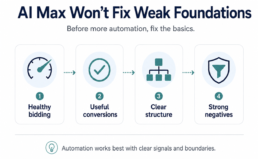
His initial checks include:
Is the target realistic?
Hans generally looks for targets that are reasonably aligned with actual performance rather than dramatically disconnected from what the campaign has historically achieved.
Are settings being changed too frequently?
Repeated changes can restrict the algorithm’s opportunity to learn and stabilise.
Are constraints limiting bidding?
Unnecessary CPC constraints can reduce the system’s learning room.
Hans specifically identified realistic targets, frequent bid-strategy changes and CPC constraints as three areas he checks when assessing Smart Bidding health.
“Before adding more AI features, I would first check whether the bid strategy is healthy. If the target is unrealistic or the settings are changing too frequently, you’re already limiting what the algorithm can learn.”
— Hans Ho, Search Consultant at FiveStones
If those foundations are weak, introducing more automation does not make the problem disappear. It can make the consequences more visible.
Broad match needs good signals, not blind trust
Experienced Search practitioners have understandable reasons to be cautious about broad match. Earlier versions could generate irrelevant traffic and substantial negative-keyword workloads.
“Many experienced practitioners are still judging broad match by how it behaved several years ago. Matching has significantly improved, but it still needs strong bidding signals and active negative-keyword management.”
— Hans Ho, Search Consultant at FiveStones
Combined with Smart Bidding, broader matching can help campaigns identify long-tail demand and queries that would be difficult to anticipate manually. That does not mean broad match should be switched on without controls.
It performs best when the account gives the system clear direction through:
- Accurate conversion tracking
- Commercially meaningful conversion actions
- Realistic bidding targets
- Clear campaign objectives
- Relevant landing pages
- Strong negative-keyword management
- Ongoing search-term monitoring
Broad match should therefore be treated as controlled expansion, not as permission to automate indiscriminately.
More campaigns do not automatically mean more control
Account structure matters too.
As an example: Hans supported an advertiser that had moved Search management from an agency to a small in-house team. The inherited account contained approximately 600 always-on Search campaigns. The sheer volume made it difficult for the team to monitor activity, identify overlap, distribute budgets effectively and spend time on strategic optimisation.
With support from Google and FiveStones, the account was eventually restructured to approximately 40 campaigns. The immediate benefit was operational: the account became easier to manage, giving the team more time for planning and strategy.
“The point isn’t that 40 campaigns is the right number. The problem was that the account had become too complex for the team to manage properly. Simplifying it gave them more time to actually optimise and plan.”
— Hans Ho, Search Consultant at FiveStones
A separate campaign may be justified because it has a distinct objective, market, budget or product group. It should not exist simply because adding another campaign feels like adding more control. For automated systems, unnecessary fragmentation can also divide data and create less coherent signals.
You do not need to automate everything at once
“Automation does not remove the need for good campaign structure. If the account contains too many overlapping campaigns, unclear objectives or weak negative-keyword management, the algorithm has no clear direction to optimise toward.”
— Hans Ho, Search Consultant at FiveStones
In reality, advertisers have different resources, risk tolerances and internal requirements.
FiveStones therefore tends to start with changes that clients can realistically adopt, such as improving the bid strategy or introducing broad match, before progressing to AI Max. Full campaign restructuring may be discussed where necessary, but it is not automatically the first recommendation because it can require significantly more time and resources. That matters because there is no value in designing the theoretically perfect AI Search account if the organisation cannot implement or manage it effectively.
The Search marketer’s job is not disappearing
As Google automates more of matching, bidding, creative and landing-page selection, practitioners will manually control fewer individual decisions. That does not mean they have less responsibility. Their responsibility is moving upward.
The practitioner increasingly needs to decide:
- Which conversions actually represent business value
- What bidding targets are achievable
- Where broader matching makes sense
- Where exclusions are needed
- Whether campaigns are overlapping
- When the algorithm needs more learning time
- When intervention is genuinely required
Hans describes this as giving automation deliberate direction rather than allowing every decision to happen independently. That requires both platform expertise and commercial judgement. An SEM practitioner who understands Smart Bidding but optimises toward the wrong conversion is still solving the wrong problem. Likewise, someone who understands the business but cannot recognise an unhealthy bidding strategy will struggle to guide an increasingly automated account.
FiveStones' view: AI makes good account management more important
AI Max, broad match and Smart Bidding can give Search campaigns more flexibility. But automation cannot reliably compensate for contradictory objectives, poor tracking, unrealistic targets or unnecessary complexity.
The strongest Search accounts will not necessarily be the ones using the most automation. They will be the ones that know where automation should have freedom, where it needs boundaries and whether the account is healthy enough to support it.
AI does not fix Search fundamentals. It makes getting them right more important.