


Written by FiveStones Marketing, based on an interview and consultation with Hans Ho, Search Consultant at FiveStones
Hans Ho advises advertisers and agencies on paid Search strategy, campaign structure, Smart Bidding and Search Ads 360. His work includes reviewing live Search accounts, improving campaign performance and helping teams adopt automated bidding and matching capabilities. The observations in this article are based on his experience working with both agency and in-house Search teams.
AI-led Search is changing how people find information.
Users can now complete more of their research directly within Google before they ever visit an advertiser’s website. At the same time, searches are becoming longer, more conversational and harder to anticipate through traditional keyword planning alone.
For Search marketers, this creates an uncomfortable question:
If impressions and clicks are falling, is paid Search becoming less valuable?
Hans, our search consultant, points out that is the wrong conclusion to jump to.
Lower traffic does not automatically mean lower commercial value
Across several Search accounts Hans supports, he has observed lower impression and click volumes while advertisers continue to invest in Search. More importantly, those declines in traffic have not necessarily resulted in an equivalent decline in conversions or return.
“We’re seeing impressions and clicks drop across some Search accounts, but that doesn’t necessarily mean conversions or ROI are dropping at the same rate. That’s why I wouldn’t judge Search performance on traffic alone.”
— Hans Ho, Search Consultant at FiveStones
That does not mean Search teams should ignore falling traffic. It means they need to understand what is happening after the click before deciding that the channel is underperforming. A user may now complete more comparison and research within the Search experience itself. By the time that person clicks an ad, they may have a clearer requirement, a narrower shortlist or stronger commercial intent.
The implication for SEM teams is simple:
Traffic volume is becoming a less useful measure of Search performance when viewed on its own.
Quality of Clicks should be the objective
Traditional Search management often placed heavy emphasis on scale:
- More impressions
- More clicks
- Higher CTR
- More traffic
Those metrics still have diagnostic value. But they should not be mistaken for business outcomes. Hans and the FiveStones team agreed that the traditional approach of simply bidding for as many clicks as possible is increasingly poorly suited to the current Search environment.
Instead, Search marketers should ask:
- Are conversions declining at the same rate as clicks?
- Is CPA or ROAS holding?
- Are leads becoming more or less qualified?
- Is revenue changing?
- Is activity shifting between Search, Shopping and Performance Max?
- Are the remaining clicks still producing commercially valuable customers?
The question is no longer simply, “How much traffic did Search generate?”
It is: “Did Search continue to connect the business with valuable demand?”
Search behaviour is changing the role of keywords too
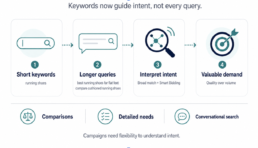
The same shift affects campaign planning. Users increasingly search using complete questions, comparisons, detailed requirements and conversational queries. A manually maintained keyword list cannot realistically anticipate every variation that may represent a valuable customer.
“People aren’t always searching with one or two keywords anymore. They’re using longer, more specific queries, so Search campaigns need enough flexibility to understand that intent.”
— Hans Ho, Search Consultant at FiveStones
This is one reason Hans sees a growing role for Google Ads/Search Ads 360 features such as broad match, Smart Bidding and AI-led Search capabilities. Keywords are not disappearing. But their role is changing from being an exhaustive list of possible searches to providing direction to a system that can interpret wider intent.
That makes the quality of the outcome even more important. If the system is being given more freedom to identify relevant demand, practitioners need a clear definition of what valuable demand actually looks like.
FiveStones' view: judge Search by business value, not traffic alone
AI-led Search does not mean clicks no longer matter. It does means clicks should be put in context. A Search account can generate less traffic and still produce valuable commercial outcomes. Equally, an account can generate large amounts of traffic while optimising toward users who contribute little to the business.
For SEM teams, the better approach is therefore to evaluate: traffic quality + conversion quality + commercial outcome, rather than traffic volume alone.
As Search becomes more automated and the user journey becomes less predictable, that distinction will become increasingly important. The future of Search measurement is not about ignoring clicks. It is about knowing when clicks are telling you something meaningful — and when they are not.